
Foreign privilege and the hidden cost of cheap labor in Mexico
By Courtney Trevino
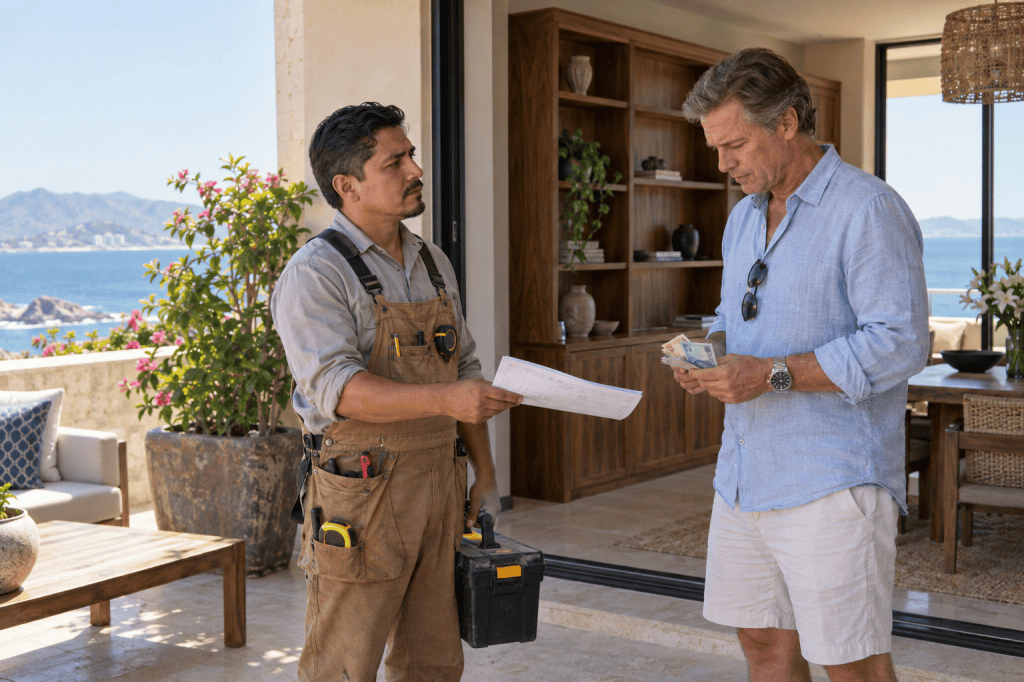
The Fear of the Gringo Tax
Foreigners in Mexico talk constantly about the gringo tax: the fear that someone will charge us more because we are American, Canadian, white, English-speaking, or simply perceived to have money. I have a friend that calls it the “gentrification tax”, which might be more appropriate. But ultimately, nobody wants to feel cheated. Asking questions about a price is reasonable. Comparing estimates is reasonable. Declining work that exceeds your budget is reasonable.
What we discuss much less often is the economic system we enter when we move to Mexico, and the people who have been underpaid within it their entire working lives.
Recently, a client of our small carpentry and home improvement business asked my husband about additional work. The original project had a detailed written scope. The client had chosen to install his cabinet doors himself, which was fine; installation was not part of the agreed price. But when another set of drawers entered the conversation, there seemed to be an expectation that my husband might install them without additional labor charges. My husband explained that the work would take significant time, especially in a small space. The client quickly decided he could do it himself.
Doing the work yourself because professional labor exceeds your budget is a perfectly acceptable choice. The part that bothered me was the assumption underneath the exchange: perhaps this additional work could simply be absorbed. Perhaps the Mexican tradesman would do it because he was already there. Perhaps his time was negotiable in a way the client’s own time and comfort were not.
The Work Behind the Finished Product
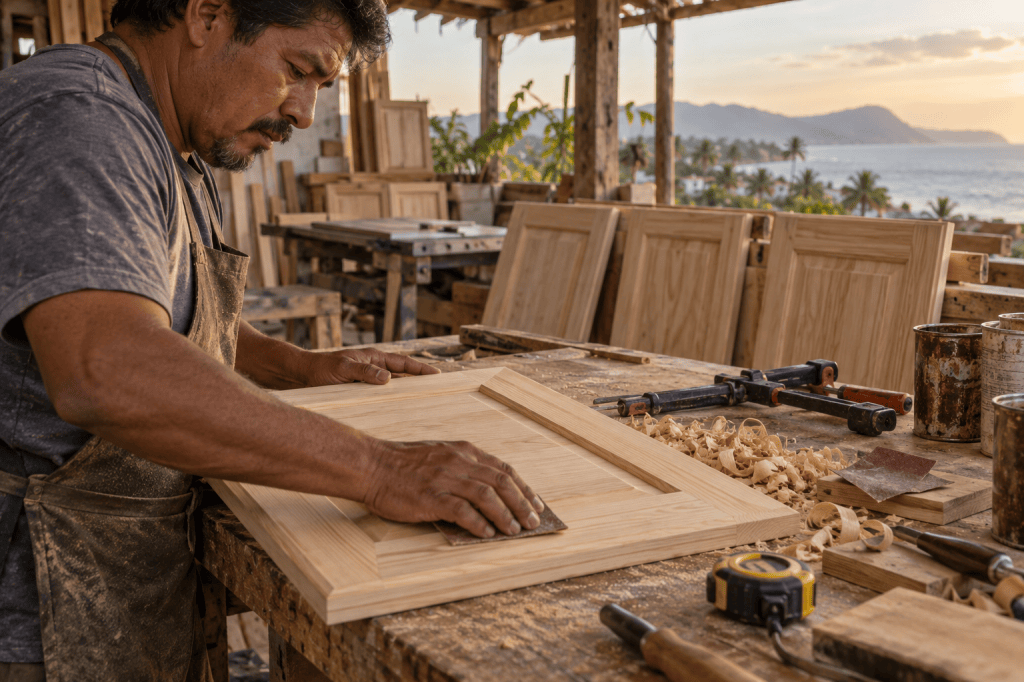
People often see only the hours a worker spends inside their home. They do not see the measurements, calculations, written estimate, material searches, trips to supply stores, transportation, fuel, tool costs, preparation, cutting, sanding, staining, drying time, cleanup, client communication, delivery, installation, or the responsibility for correcting a problem if something goes wrong.
Foreign clients may also expect English-language communication, detailed written estimates, dependable scheduling, custom design, professional finishing, and results comparable to what they expect in the United States or Canada. Those expectations are not wrong. But they describe a premium service. It is unreasonable to demand that level of service while insisting that the person providing it accept the lowest possible local wage.
My husband is not selling spare minutes. He is selling skilled labor developed over decades. He fabricates custom pieces, understands materials, solves construction problems, works with specialized tools, transports heavy products, and assumes responsibility for the finished result. His work may cost less than comparable work in the United States or Canada. That does not make his knowledge, body, or time less valuable.
Twenty Years of Labor for One Hundred Pesos an Hour
Before starting our business, my husband spent almost twenty years working in industrial construction. To earn roughly 100 pesos per hour, he worked about 55 hours a week. When the company required more hours, it paid approximately 100 pesos more for each additional hour rather than paying a meaningful overtime premium.
He also had to travel across Mexico to earn that wage. Companies sent him to projects far from home, commonly for about a year at a time. The wage came at the cost of long workweeks, dangerous conditions, physical wear, and separation from the people and place he loved.
As of 2026, the general minimum wage in most of Mexico, including Nayarit, is 315.04 pesos for a full day of work. That is the legal floor, and many people genuinely live near it. Mexico’s Federal Labor Law now describes decent work as work that respects human dignity, provides a remunerative wage and social security, and protects workers through safe and hygienic conditions. The law also says ordinary overtime should be paid at 100 percent above the regular hourly wage. The language recognizes human dignity. Too many workplaces do not.
I genuinely want to ask you: can YOU live on 315.04 MXN per day? And if you cannot, why would you be comfortable asking anyone else to? Because if not, why would you expect anyone offering quality craftsmanship to work for you at what is effectively exploitative labor rates?
The Day a Worker Died in La Cruz
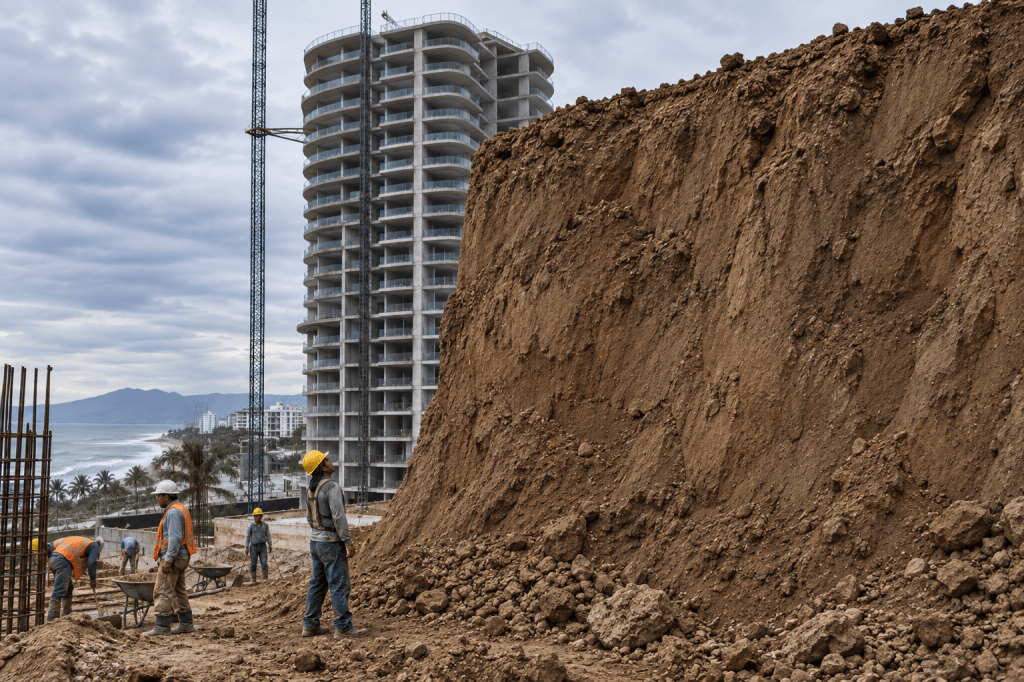
About two years ago, my husband was working on the foundation of a condominium project in La Cruz de Huanacaxtle. Excavated dirt had been piled into a freestanding vertical wall. He looked at it and recognized the danger. Loose earth does not behave like a constructed wall. It needs a stable slope, much like the natural slope of a mountainside. He believed the dirt could give way.
Shortly before lunch, it did.
A worker was walking near the dirt wall when it collapsed and buried him immediately. Several men tried to reach him. My husband knew the weight of the earth and the lack of air had probably already killed him.
The men left for lunch. When they returned, the engineers ordered them back to work while the dead man’s body was still under the dirt.
My husband was personally given that order.
The work stopped only after SEMEFO, the forensic medical service, and another government authority arrived. The next day, the company asked the workers for donations for the dead man’s family. The same workers who earned modest wages and had been ordered to continue working beside their buried coworker were asked to carry the company’s moral responsibility too.
I keep returning to that detail. The company exercised enough authority to send men back into the workplace where a man had just died. Yet when his family needed help, responsibility was passed down to the other workers.
The Law Exists and Workers Still Die
Mexico does have construction-safety rules. NOM-031-STPS-2011 applies to construction projects throughout the country. It requires employers to identify serious risks, establish safety systems, prepare emergency plans, train workers, report workplace accidents, and investigate how those accidents happened. It also requires stable slopes and protective measures where earth may collapse. The labor authorities within the Secretariat of Labor and Social Welfare, along with corresponding state authorities, perform the inspection role that Americans may associate with OSHA.
The existence of a standard did not save that worker. A regulation matters only when employers follow it, workers can report violations without risking their livelihoods, and authorities enforce it before someone dies.
This is why I call the system modern slavery. I am not claiming that Mexican construction workers are legally owned, nor am I erasing the history of chattel slavery. I am describing modern labor and human exploitation: people working punishing schedules for wages that leave little room to refuse, traveling wherever an employer sends them, risking their bodies and their lives, and knowing they can be replaced the moment they become inconvenient. A choice made under relentless economic pressure is not the same as meaningful freedom.
Where I Stand
I need to be clear about the position from which I am writing. I am a white American woman, and I benefit from economic and currency privilege in Mexico. I am also half Mexican. I speak Spanish, which I learned as an adult. I live in a local community rather than an expatriate condo enclave (nothing wrong with choosing to live where you choose to live, so no judgment here). My husband is Mexican, and my relationships with Mexican people are friendships and family relationships, not merely transactions with waiters, housekeepers, gardeners, or construction workers.
None of that makes me the spokesperson for Mexico, and it does not remove my privilege. It does mean that I hear conversations many foreigners never have. I see what wages require from the people earning them. I hear what happens on job sites after the English-speaking clients and condo owners leave.
It is possible to live in Mexico without speaking Spanish. It is much harder to claim genuine assimilation while remaining unable to have an unmediated conversation with most of the people around you. How can you understand workers’ experiences if you cannot speak with them about their lives? How can you understand the difference between the rights written into Mexican labor law and what happens in practice if your contact with Mexican people occurs mainly through service relationships? Proximity is not the same as understanding.
The Other Side of the Local Price
Foreign residents are often quick to interpret an unexpected price as proof that someone is trying to take advantage of them. Sometimes dishonest pricing happens. It happens in every country. But the possibility of a gringo tax or gentrification tax does not erase the much larger power imbalance between a foreign resident with access to dollars and a Mexican worker trying to support a family in pesos.
A person who moves to Mexico with foreign income, savings, property, or remote employment has choices that many local workers do not. Using that advantage to force prices lower is not assimilation. It is participation in the same system that has always treated Mexican labor as cheap and replaceable. Ultimately, it is an abuse of power, and it’s disgusting.
There is also a contradiction in demanding the local price while expecting foreign standards. You want someone who speaks English. You want detailed communication, accurate measurements, dependable scheduling, customized work, clean finishes, delivery, installation, and accountability. You want the experience to feel familiar. But when the price reflects the real work required to provide that experience, you suspect you are being cheated.
You cannot demand more and insist that the worker remain cheap.
Asking a Mexican worker to include one more task for free is obviously not equivalent to ordering men back to work while their coworker remains beneath a collapsed wall. But both behaviors grow from the same devaluation: the belief that Mexican labor is abundant, inexpensive, and less worthy of compensation or protection.
What Respect Looks Like
Nobody is obligated to accept a quote. If the price exceeds your budget, reduce the scope. Postpone the project. Seek another legitimate estimate. Do part of the work yourself. Those are honest choices.
What is not honest is demanding premium work while treating a worker’s need to earn a living as a bargaining weakness. A fair transaction should leave both people feeling respected. The goal should not be to discover how little a person can be persuaded to accept.
Foreign privilege is not only the ability to spend more. It is the ability to walk away from conditions that other people must endure. If we bring that privilege to Mexico, we can use it to press workers further down, or we can use it to raise the floor beneath them.
Instead of boasting that you secured the cheapest local deal, be proud that you paid fairly. Be proud that the person who improved your home can improve his own. Be proud that your comfort did not require someone else’s exploitation.
Your Mexico discount should not come out of another person’s paycheck. If you cannot afford the work, do less work. Do not ask the worker to surrender more of his life so that you can keep more of your money.


Leave a comment