
Why “Is Mexico safe?” may be one of the least useful questions we ask
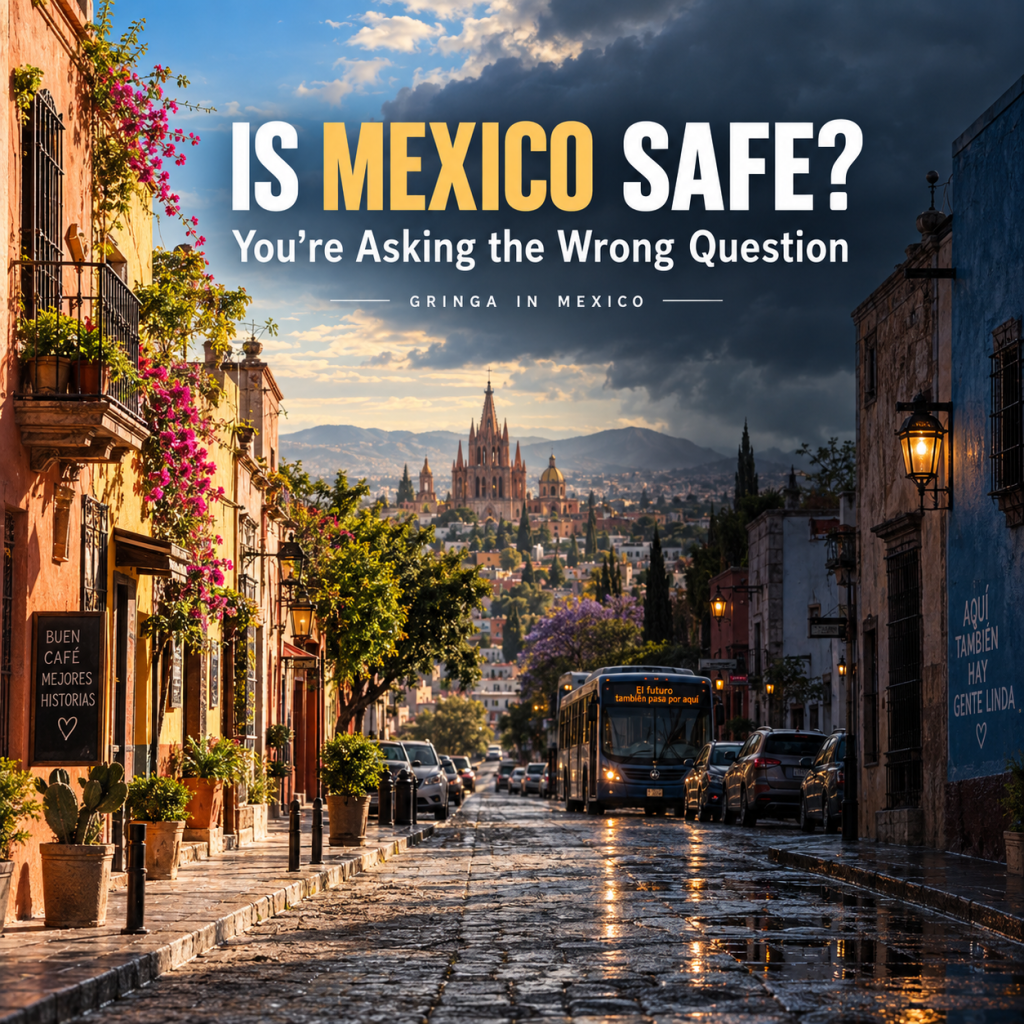
By Courtney Trevino
“Is Mexico safe?”
It may be the most common question people ask before traveling to Mexico or considering a life here. It also may be one of the least useful.
What does safe actually mean? Does it mean that nothing bad will happen? That something bad is statistically unlikely to happen? That we understand the dangers well enough to avoid them? Or simply that we feel comfortable?
| Danger is real, but “safe” is a judgment we construct from risk, familiarity, control, privilege, and personal experience. |
Safety is not entirely a social construct. Some dangers can be measured: homicide, robbery, sexual violence, traffic deaths, disappearances, emergency-response times, natural disasters, and access to medical care. But none of those statistics, individually or collectively, can tell one particular person whether they will feel—or actually be—safe in one particular place.
What are we actually asking?
When someone asks, “Is Mexico safe?” what are they really asking?
- Am I likely to be murdered?
- Could I be robbed or scammed?
- Is it safe for a woman to walk alone?
- Can I drive at night?
- Will the police protect me?
- What happens if I have a medical emergency?
- Can I trust the legal system?
- Will I understand the dangers around me?
- Can I live there without constantly feeling afraid?
Those are entirely different questions. They describe different threats, different institutions, and different levels of personal control. Compressing them into one word—safe—creates the illusion that a country can provide a single, permanent verdict.
It cannot. Mexico is too large and too varied to be one risk environment. Safety changes from state to state, neighborhood to neighborhood, highway to highway, and sometimes from noon to midnight on the same street. The same is true of the United States.
Safety can be measured—but only in pieces
Statistics matter. Violence is not imaginary simply because it happens outside our own field of vision, and personal experience cannot cancel population-level evidence.
Using the most recent reasonably comparable national figures, Mexico’s 2023 homicide rate was about 25 per 100,000 people, compared with about 6 in the United States. Mexico’s national rate was therefore more than four times higher. That is a real and consequential difference.
Mexico’s 2024 victimization survey estimated approximately 6,003 incidents of robbery or assault in the street or on public transportation per 100,000 adults. The closest U.S. victimization measure was about 220 robberies per 100,000 people age twelve or older. The categories are not identical, so the exact multiple should be treated cautiously, but the broad conclusion is difficult to dismiss: street and public-transport robbery are much more common in Mexico.
Other measures complicate the familiar narrative. In 2022, road-death rates were nearly identical: about 12.4 deaths per 100,000 people in Mexico and 12.8 in the United States. National surveys have found lifetime sexual-violence prevalence among women to be devastatingly high in both countries—49.7 percent in Mexico and 45.1 percent in the United States—although the surveys define and ask about sexual violence differently.
Natural-disaster risk is also part of safety. The 2024 WorldRiskIndex ranked Mexico fifth among 193 countries for its combination of exposure and social vulnerability; the United States ranked nineteenth. Mexico faces especially high exposure to earthquakes, hurricanes, floods, drought, and other climate-related hazards.
These figures do not prove that every person in Mexico faces four times the homicide risk of every person in the United States, or that every American is more likely to die on the road. National averages describe the burden carried by a population. They do not describe exactly who carries it.
The numbers depend on a government willing to count
Crime statistics tell us something real, but they are shaped by what victims report, what police record, what prosecutors investigate, and what governments are willing—or able—to acknowledge.
An earlier estimate cited in the book Mexico’s Human Rights Crisis described impunity in even starker terms: 99.9 percent of crimes going unpunished, roughly one percent reaching trial, and only 0.3 percent resulting in conviction. A newer national analysis by México Evalúa uses a different funnel and terminology, but reaches a painfully consistent conclusion. It estimated that 99.23 percent of crimes committed in Mexico either are never reported or do not receive an effective resolution. Roughly 93 of every 100 crimes are never formally reported. Of the seven that enter the system, only about 10.58 percent are resolved. That leaves approximately 0.77 of every 100 crimes with an effective resolution.
People often describe that outcome by saying almost all crime “goes unresolved.” Technically, the funnel combines non-reporting with institutional impunity. Practically, the result is the same for most victims: no meaningful justice.
Victims frequently decline to report because the process consumes time, exposes them to retaliation or humiliation, could potentially draw undesired attention, and appears unlikely to produce a result. Then the lack of reports becomes part of the government record used to describe the level of crime. The record is not false, exactly. It is incomplete in a systematic direction.
For my family, robbery is not an abstract category
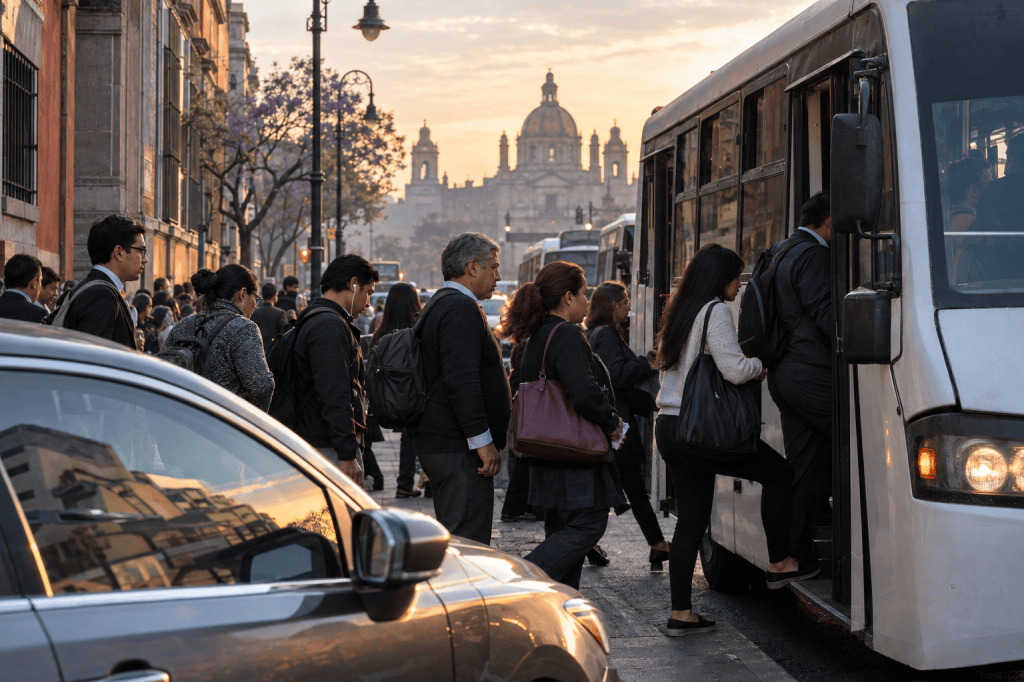
My husband is from Valle de Chalco, in the State of Mexico. He has been robbed multiple times while using public transportation. A fourteen-year-old cousin of his was murdered during a robbery on public transport. The wife of one of his friends was murdered during the robbery of her vehicle.
He has also been robbed inside his own home. The assailants were known. The police still did not produce a conviction.
Those experiences do not substitute for national data, but they explain what the data represent. Six thousand street and public-transport robberies per 100,000 adults is not an anti-Mexico talking point to the people who commute through that risk every day. It is a pattern that enters families as lost phones, lost wages, trauma, injury, and sometimes death.
It also shows why two people living in the same metropolitan area can answer the question “Do you feel safe?” completely differently. A foreign resident who drives a private vehicle from a guarded development to a restaurant may inhabit the same region as a worker who takes two combis and a bus before sunrise. They do not inhabit the same exposure.
The disappeared—and the records that fail them
By mid-2026, Mexico had approximately 135,000 people registered as missing or disappeared and tens of thousands of unidentified bodies or remains in public custody. Yet the government’s own review found that about 46,000 missing-person records lacked basic information necessary to conduct a search. Among another 43,128 records containing fuller information but showing no subsequent activity, fewer than ten percent had a corresponding criminal investigation.
That is not merely a database problem. It is evidence of years in which prosecutors and law-enforcement agencies did not consistently open files, gather evidence, coordinate across states, or follow cases. Families have repeatedly accused authorities of neglecting investigations, reclassifying disappearances, and trying to reduce the politically damaging count instead of finding their loved ones. The government says records are being corrected rather than erased. Families have good reason to fear the difference.
Mexico has long possessed pieces of the technology required to do better. A 2017 law mandated a National Forensic Data Bank capable of consolidating DNA, fingerprints, missing-person records, grave data, and information about unidentified remains. Operational guidelines did not appear until 2023, years after the legal deadline, and state and federal databases have remained fragmented.
The contrast is difficult to ignore. Mexico deployed biometric border-control systems at major airports years ago, including automated identity verification for international travelers. Yet the country was extraordinarily slow to build and integrate forensic systems that could compare fingerprints, genetic profiles, missing-person reports, and unidentified remains.
Since 2025, the federal government has moved toward a biometric CURP and a unified identity platform partly justified as a tool for locating missing people. That development makes it inaccurate to say Mexico has categorically refused all biometric matching. But it does not erase the years of delay, fragmentation, missing records, and institutional resistance that preceded it. Technology was available. What was missing was sustained coordination, resources, accountability, and political will.
| When the state fails to investigate, the absence of a conviction does not prove the absence of a crime. Sometimes it proves the absence of a functioning path to justice. |
Feeling safe and being safe are not identical
Human beings do not experience safety as a spreadsheet. We experience it through familiarity. We tend to feel safer around dangers we understand and around people we perceive as being like us.
This is one reason immigrant and expatriate “bubbles” form (see my blog post on The Gringo Bubble). People seek familiar language, food, expectations, humor, and social rules. Those communities can provide genuine support, especially during the disorienting process of learning a new culture. But they can also become insulation. If our daily routines keep us inside a foreigner-oriented neighborhood, private transportation, English-speaking businesses, and private healthcare, we may mistake our protected experience for the experience of the country around us.
There is also an unconscious in-group bias at work. Even people who sincerely consider themselves open-minded may initially feel more comfortable around people who look, speak, worship, or live as they do. Xenophobia is not always expressed as open hatred. Sometimes it appears as an unexamined feeling that the familiar is trustworthy and the unfamiliar is risky.
Integration requires us to notice that response without pretending we are morally above it. Familiarity can help us navigate danger, but it can also distort our perception of danger.
We normalize the risks we grew up with
I have spoken with Mexicans who imagine the United States as a gun-wielding place where it is too dangerous to send a child to school or visit a shopping mall because someone may open fire. Americans often look south and see cartel killings—brutal, theatrical, and deliberately displayed to terrorize communities.
Neither fear is invented. Mass shootings in the United States are real. Cartel violence in Mexico is real. Both governments could do more about the forms of violence they have allowed to become culturally and politically entrenched.
Gun violence in the United States is not abstract to me. I have lost two immediate family members to it—one to homicide and one to suicide. I cannot know with certainty what would have happened if guns had not been so readily present in American life. But I also cannot pretend that the availability of a firearm was irrelevant. National risk becomes family history: a death, an empty chair, a before and an after.
When my daughter was young enough to attend school, we talked about what she should do if an active shooter came onto campus. American schools now routinely maintain active-shooter plans and conduct lockdown drills. That particular conversation is not a routine feature of childhood in Mexico in the same way. It is one of the dangers Americans can normalize because it belongs to the environment we already know—even though explaining to a child how to hide from a gunman is not normal at all.
But we are often more frightened by unfamiliar violence than by familiar violence, even when the familiar danger is statistically significant. We understand the social rules surrounding the risks we grew up with. We know which neighborhoods to avoid, when to leave, what behavior looks suspicious, and whom to call. In another country, we may not know any of that. Uncertainty magnifies fear.
The most dangerous place may look like home
Domestic violence exposes another weakness in the way we talk about safety. It exists in every country and affects people of every class and culture. Although men can and do experience domestic abuse, the physical power imbalance means women are far more likely to fear serious injury or death at the hands of a male partner. In the United States, more than half of female homicide victims are killed by a current or former male intimate partner. Globally, the United Nations has repeatedly described the home as the most dangerous place for women and girls in terms of homicide risk.
Home is, by definition, where a person is supposed to be safe. Yet intimate-partner violence is often treated as private, ordinary, or somehow separate from “public safety.” It is familiar violence, hidden behind walls. Cartel killings and mass shootings dominate our imagination because they are spectacular. Domestic violence can be statistically common, chronically underreported, and no less terrifying—and still fail to shape the way we label an entire place.
This is what we do when we decide which dangers count. We do not merely measure risk. We rank it emotionally.
Healthcare is part of safety, too
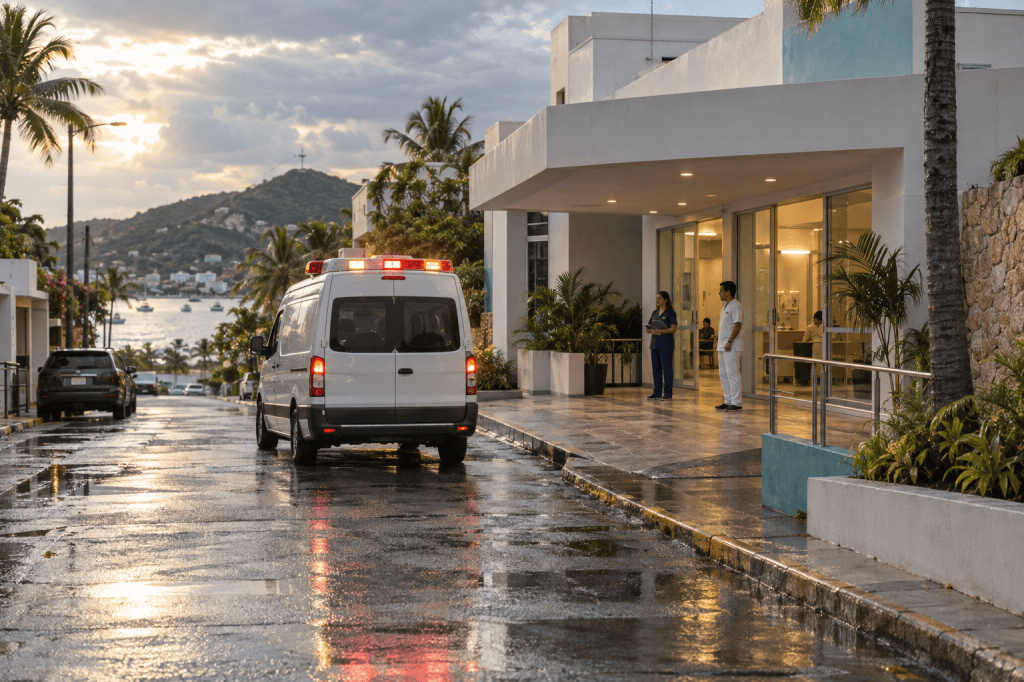
A person can live in a low-crime neighborhood and still be unsafe if an ambulance does not arrive, the local hospital lacks medication, or care is unavailable without cash.
Mexico recognizes healthcare as a right and operates large public systems, principally IMSS, ISSSTE, and IMSS-Bienestar. Citizens and legal residents have routes into public care, but the system remains fragmented by employment, enrollment, institution, and state. Mexico is now working toward a more integrated universal service, with major phases scheduled to begin in 2027. That future plan is itself an acknowledgment that legal entitlement and practical access have not yet become the same thing.
Public care is not uniformly poor. Mexico has excellent physicians and public hospitals that save lives every day. But the experience is inconsistent and frequently under-resourced. Mexico spends far less per person on healthcare than the OECD average, and patients and healthcare workers continue to report shortages of antibiotics, analgesics, cancer medications, beds, equipment, and basic supplies. Delays and shortages can turn treatable conditions into disabilities or medical crises.
Private healthcare often offers faster access, more comfortable facilities, and a more predictable patient experience—but only for people who can pay. Private hospitals commonly request a substantial deposit or proof of payment before admission. Even insured patients may need a credit card or cash while the hospital and insurer determine whether coverage will be guaranteed. In an emergency, “I have insurance” is not always the same as “the hospital has agreed to bill my insurer.”
The WHO–World Bank essential-service coverage index gave the United States a score of 88 in 2023 and Mexico 79. That does not mean the American system is simple, equitable, or affordable. It means that, at the population level, the United States has broader coverage of essential services. A foreigner with dollars purchasing private Mexican care may nevertheless experience Mexico’s system as cheaper, faster, and more accessible than the U.S. system. Both statements can be true because safety is not distributed equally.
Safety is not distributed equally
An affluent foreigner in a guarded development, a local woman commuting by bus, a journalist investigating organized crime, a business owner facing extortion, and a tourist inside an all-inclusive resort may occupy the same state. They do not occupy the same Mexico.
Money changes exposure. So do nationality, skin color, gender, age, language, occupation, neighborhood, transportation, family connections, and daily routine. Privilege does not make a person invulnerable, but it can purchase distance from certain dangers: a private car instead of a bus, a gated entrance instead of a street-facing door, a private hospital instead of a crowded public waiting room, a lawyer instead of a confusing bureaucracy.
This is why “I have lived here for ten years and nothing has ever happened to me” is not proof that a place is safe. It is evidence about one person’s experience. It may reflect good judgment. It may reflect privilege. It may reflect geography. It may also reflect luck.
The better question is specific and personal
Instead of asking, “Is Mexico safe?” we might ask:
| What are the most likely risks for someone like me, in this particular place, living the way I intend to live—and what would I need to do to reduce them? |
That question forces us to name the place, the person, the activity, and the danger. It leaves room for evidence without pretending that evidence can eliminate uncertainty.
It also allows a person to make an honest decision. Someone may understand that a particular risk is higher in Mexico and still decide that the life available there is worth it. Someone else may examine the same information and decide it is not. Neither decision requires pretending the danger is imaginary—or that danger is the only thing a country contains.
So, what is safety?
Perhaps safety is not a condition a place either possesses or lacks. Perhaps it is a relationship between a person and a place—a relationship shaped by probability, knowledge, resources, identity, behavior, institutions, and chance.
Mexico is not simply safe or unsafe. Neither is the United States. Neither is anywhere.
The more useful question is not whether danger exists. It is whether we understand the danger, whether the systems around us are capable of responding when something happens, whether we are equipped to navigate the risks we are likely to face, and whether the life available to us is worth the risks it asks us to accept.
 Gringa in Mexico
Leave a comment