
The way we approach the ocean mirrors how we navigate life. Sometimes we float, sometimes we dive deep, sometimes we sink. But we always return stronger with the tides.
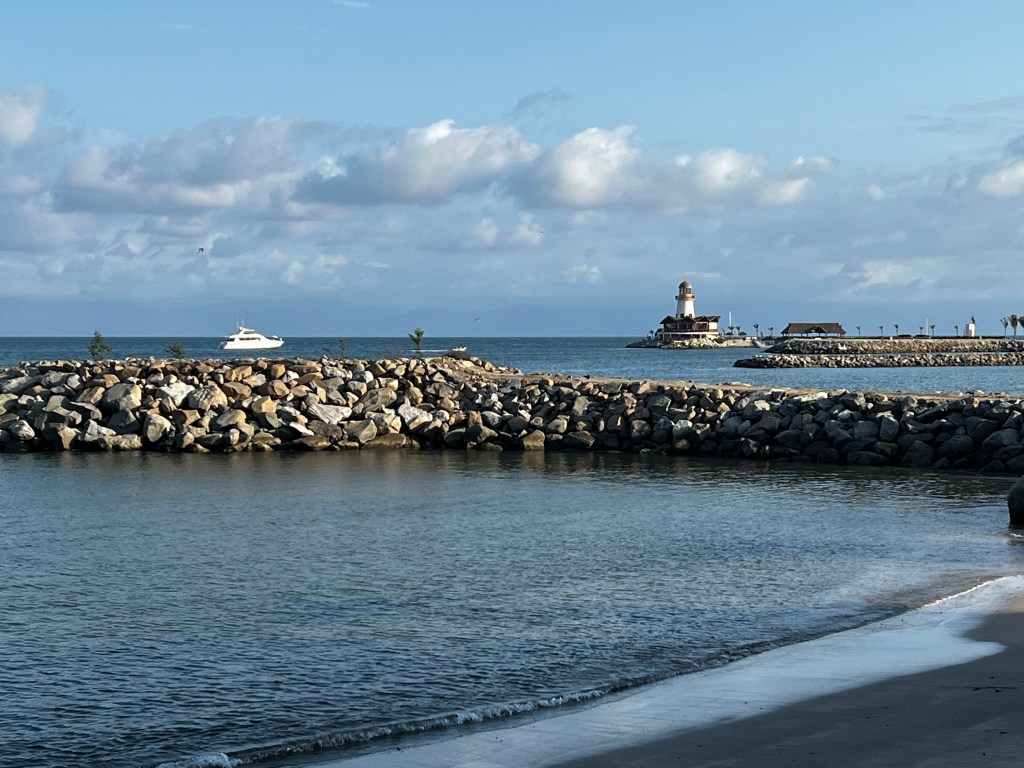
Living close to the La Cruz marina is nothing short of glorious. With 340 slips, it is the largest marina on Mexico’s Pacific coast. It boasts a vibrant community and hosts events ranging from movie nights and Sunday markets during high season, to party boats and whale tours. Weekday mornings bring an active crowd who walk or jog the ¼ mile to the marina’s edge and back, making it a solid ½ mile trek. Pickleball courts are at the entrance to the marina, but I hear that the waitlist to secure a court is like 10 years long and the deposit to hold your reservation must be paid in blood (just kidding, but no seriously, it’s hard to get a reservation on those courts).
But there’s another morning activity for those adventurous enough to try it—one I have grown to cherish deeply.
Ocean swimming.
When in Mexico, on average of three days a week, I meander down to the vast ocean at the edge of the La Cruz marina. As I stand on the beach, I imagine the infinity that lies beyond what my eyes can see. The mountains surround me, their peaks blending into the horizon. I imagine the whales and dolphins just off the shore, as Bahia is a very deep bay quite close to shore. Some mornings, if I am lucky, I don’t have to imagine them: I SEE them! Looking out far enough, it’s unclear where the ocean ends and the sky begins. What is clear that all of this is bigger than I am.
Yet, despite my smallness, I am here. I matter. My presence is part of something greater—something universal that we all belong to.
From Confined Pools to Boundless Oceans
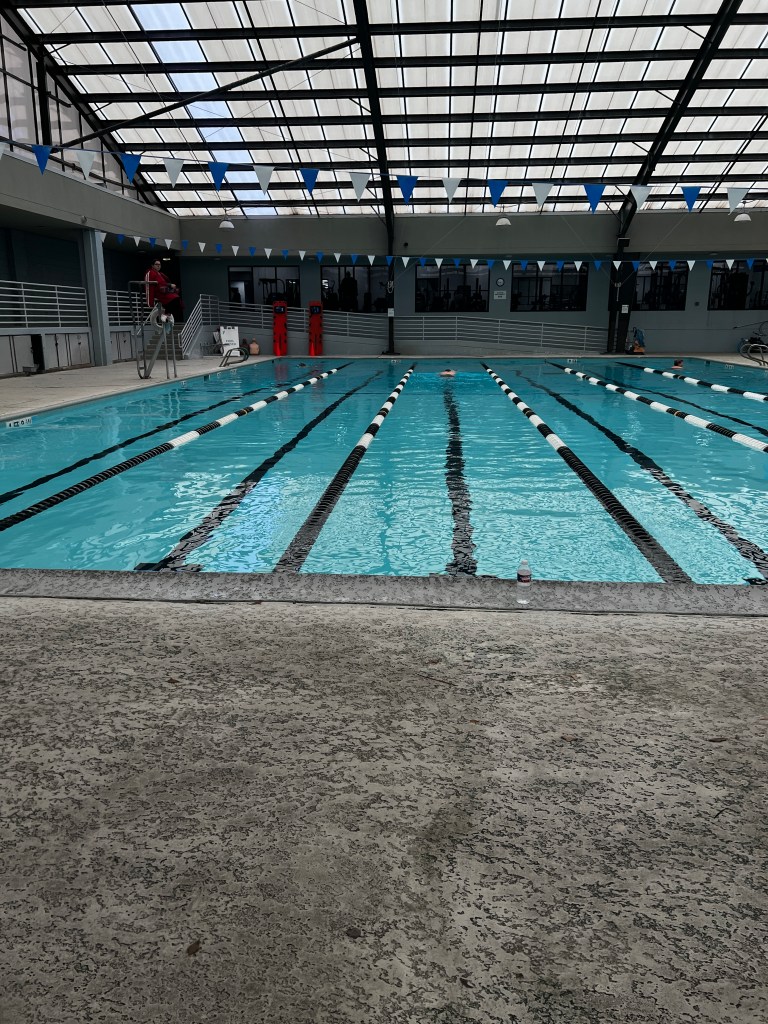
There’s something profoundly liberating about swimming in the ocean compared to a pool.
Not that there’s anything wrong with swimming in a pool. When I am in Houston, I swim at the local YMCA to maintain fitness (and my sanity). But it’s not the same. Pool swimming often makes me feel like a caged animal, confined within man-made boundaries. The repetitive laps, the smell of chlorine, and the sterile surroundings make me feel trapped. Chlorinated water up my nose just isn’t the same as saltwater up my nose. The whole time I’m swimming in the pool, I’m dreaming of swimming free in the ocean.
It’s as if swimming in a pool serves as a metaphor for life’s limitations—the decisions made beyond our control that ultimately shape our paths. We have these boundaries that we think that are not within our control. We have the freedom to move, but only within our lanes, and within the confines of the pool itself. If pool swimming is all I have available to me, then I will accept it.
But deep down inside, I know the truth: I don’t want to stay in my lane. I don’t want to be confined. I want more than the pool. I want freedom. I want the ocean.
Swimming in the ocean is an entirely different experience. Its vastness represents wild freedom and unpredictability. Of course, swimming in freedom comes with its own set of challenges. The ocean is alive, teeming with creatures both fascinating and formidable. I’ve encountered jellyfish—both harmless and the kind that leaves you nursing wounds for weeks—manta rays (their stings hurt like hell too), schools of fish, and even glimpses of whales and dolphins. There have been moments of unease, especially when I spot eels or sea snakes, and my imagination makes me wonder what else is out there that I can’t see.
There’s also the mental aspect of it, where I think I see something out of the corner of my eye, or something touches my foot, and it sends my imagination into overdrive.
Once, I couldn’t get a grip on my mind and had to end my swim early. I had thought I saw something out of the corner of my eye, but then I didn’t know if I really saw it, and then I got a bad feeling about it, and then I was like, “Calm down, it’s just your imagination”. But I couldn’t shake the feeling, and then I was like, “What if the universe is trying to tell me that there IS something out there?” or “What if I am calling this into existence because I am thinking about it?” That’s when I was like, “Yeah, I’m done here,” and swam for the shore.
But I guess these experiences add to the raw, untamed beauty of the ocean, and the experience of ocean swimming itself.
The Unexpected Companions: Crocodiles, Sharks, and Fear
One of the more surprising revelations was learning about the crocodiles in the waters around Bahia de Banderas. One afternoon, my partner Edgar and I entered into a discussion on this topic after a crocodile was seen on the beach. He said that they live in the ocean. I scoffed at the idea, convinced that crocodiles couldn’t adapt between freshwater and saltwater environments without compromising their homeostasis. I then (somewhat pompously) stated that any crocodiles in the ocean would die within a couple weeks’ time due to the homeostatic imbalance.
Turns out, I was wrong, and Edgar was so very right. Apparently, some crocodiles are remarkably adaptable, moving seamlessly between rivers, tributaries, and the ocean. Nature, as always, finds a way—and, of course, so do these crocodiles that live in the Bay. You know, you really gotta hand it to these crocs. They really are the ultimate survivors. On a serious note, of all of the predators that are in the ocean, it’s these crocodiles that scare me the most.
But Edgar has a fear of a different marine life animal that pricks the hairs on the back of his neck when he’s swimming in the ocean: sharks. Now here, we don’t really see too many sharks in Bahia de Banderas. He knows the fear it’s unrealistic, and I usually take this moment to remind him that if anything were to get him in these waters, it would likely be a crocodile, not a shark. I’m usually met with a look that silently says, “That’s not helpful.”
Maybe not. But it’s true.
There’s nothing wrong with having fear. Fear is part of life, and there are certain fears that all of us have that are designed to keep us alive. Ocean swimmers are no exception. The difference is, we’ve learned to distinguish between fears that keep us alive and the fears that keep us from living. Fear isn’t always logical, but understanding it helps us manage it. While fear may never fully disappear, working through it can keep it from controlling us—and that’s progress.
And while we are on the topic of ocean swimming and fear, what is the real fear here? Is it really the shark that we fear? Or the crocodile? Or is it that there could be an unseen predator lurking? Is it a fear of the unknown, a sense of this feeling of lack of control? Is it dying?
How do we confront that fear and move through it without letting it hold us back? What shift in mindset allows that transformation?
Personal Histories: Learning and Teaching Swimming

My relationship with swimming began early. I took lessons as a child and quickly became proficient. However, my mother, swayed by cultural fads and her own aspirations, pulled me from swimming to enroll me in gymnastics, inspired by Mary Lou Retton’s Olympic success. (I even had a replica of her famous leotard.)
Despite the shift, my early swimming foundation stuck with me. I always thought myself to be a relatively good swimmer; that is, until I tried ocean swimming. Oh. My. God. In my experience, it really is NOT the same. Yes, the strokes, motions, and rhythms are the same. And you are in water. That’s about it on what there is in common.
I’ve already listed some of the differences: marine life, fears of the unknown, wild environment. But it’s also the waves! Sometimes the waters can be quite choppy, and even when you are breathing opposite of the currents, they still somehow seem to surge up and right into your mouth as you are gasping for air. With waves and currents like that, it’s like the water is coming from every which angle. And if the water is choppy enough, it’s enough to give you motion sickness.
And navigating the currents? If they are strong enough, you’ll swim against them and barely move. It’s like you are swimming just to maintain position. To make progress, you’ve got to swim hard, kick those feet, and change angles to try and get out of the current, all while remaining vigilant of your surroundings. I tell myself the same thing navigating currents as I tell myself when navigating difficult times in life: that this too shall pass.
When I became a mother, I felt it was my responsibility as a parent to ensure that my daughter Aliyah knew how to swim at a young age. I’d heard stories growing up, whether on the news or through stories of children drowning in pools, oceans, even bathtubs. When she was 3, I enrolled Aliyah in swim programs at FINS and later the YMCA, where I feel that she learned the basics as well as various strokes.
But real learning often comes from real experiences. One afternoon many years ago, after the swim lessons and while at a pool in our local neighborhood, I noticed Aliyah struggling in the water. She was about 6 or 7 years old at the time, and I believed her to be a pretty good swimmer. Two lifeguards didn’t seem to notice her struggling against the water, but I did. I jumped in and pulled her out just as she was going under. She had panicked, forgetting the basic survival skill taught in every class—flip onto your back and float.
Despite her knowledge and skills, in her moment of panic, she forgot it all.
This incident became a pivotal learning moment for both of us. It emphasized the importance of staying calm under pressure and knowing when to ask for help. I’m proud of my daughter, as she hasn’t allowed that near-drowning experience prevent her from swimming again. In fact, she’s an excellent swimmer. She went on to do swim team, and it was my daughter’s desire to ocean swim is what I feel inspired me to begin my own ocean swimming journey.
Edgar’s Journey with Ocean Swimming

My partner, Edgar, has a different relationship with the ocean as a result of his near-drowning experience. Growing up in Mexico City, he had limited exposure to natural bodies of water. Swimming pools—especially those designed for lap swimming rather than lounging—were a luxury and not accessible for him. Edgar’s introduction to ocean swimming was a trial by fire—or rather, water.
During a trip to Acapulco, Edgar and a friend ventured into the ocean, not far from the shore. Suddenly, a strong current pulled them out to sea. With limited swimming skills and mounting panic, Edgar believed he was moments away from drowning. Miraculously, two lifeguards appeared and saved them. That experience profoundly changed him. Edgar approaches the ocean with a deep respect, fully aware of its power.
Edgar’s relationship with ocean swimming has been a journey of evolution. He often feels he tires quickly. He used to smoke cigarettes, but he may need to strengthen his lungs, and swimming is fantastic for that. But I suspect it’s as much a mental hurdle as a physical one. Surviving a near-drowning experience isn’t something that you would soon forget, and that experience stays with you as a testament to the power of the ocean. I can imagine that in the very least, it would make you feel short of breath.
But with each swim, Edgar becomes more attuned to the ocean’s rhythms. He’s learning that it’s not about fighting the water but moving with it—accepting its unpredictability and finding peace within its vastness, but also knowing your own strength and skills as well as limits. Each ocean swim gives him more confidence, helping him rewrite the story he’s been telling himself for so long: that he can’t swim, that he’s not a good swimmer, other stories like that.
What’s crazy is that he actually IS a good swimmer: he swims three days a week, has developed good form, and has good endurance.
He IS making progress. And so am I. We all are.
The Ocean as Life’s Metaphor
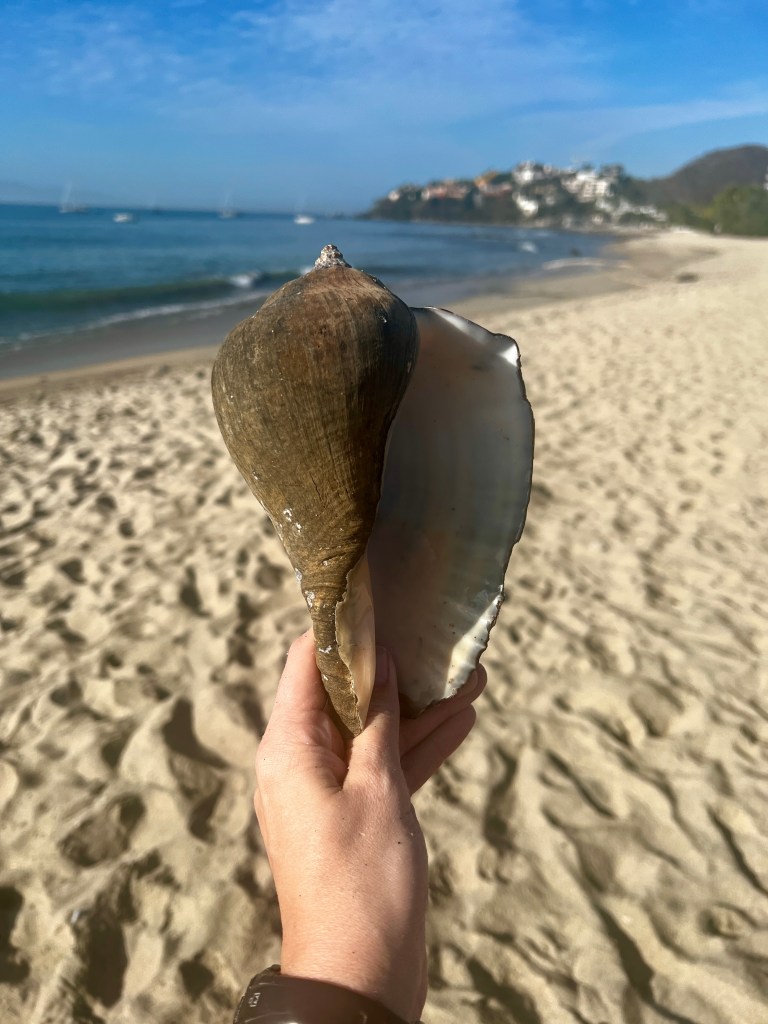
Ocean swimming mirrors life in many ways. Ocean swimming allows each person to show up wherever they are at in their journey and just go from there. The ocean is uncontrollable, much like life itself. We can’t dictate the waves or the creatures we encounter, but we can choose how we navigate them. Murky waters, jellyfish stings, or even the looming thought of crocodiles—all these challenges test our resilience.
As in life, there is fear in ocean swimming. The key is to realize the difference between the fears that keep us alive from the fears that keep us from living. When we face our fears, we are able to see what is on the other side: freedom.
The ocean offers moments of unparalleled beauty and freedom. It teaches humility, reminding us of our smallness in the grand scheme, while simultaneously empowering us to embrace the vastness of existence and the things that we cannot control. It reminds us that life is all about the journey.
Swimming in the ocean isn’t just about exercise or adventure; it’s a deeply meditative practice. It forces you to be present, to be aware of your surroundings, to respect nature, and most importantly, to respect yourself—to know your limits, to face your fears, and to capitalize on your strengths.
In the end, whether it’s navigating ocean currents or life’s unpredictable tides, the key is the same: don’t fight it.
Go with the flow, learn from it, and let it transform you.
Because what else are you going to do?
Fight the ocean?
 Gringa in Mexico
Leave a comment